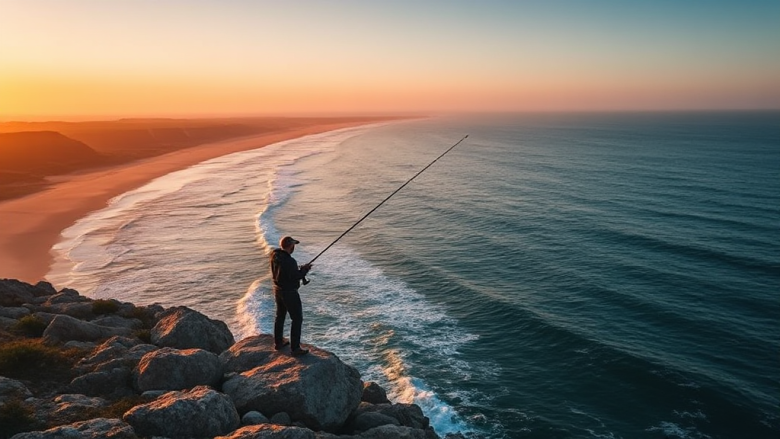
One Fishing License, Twelve Coastlines: A Regional Guide to Portugal’s Shoreline
Picture the Portuguese mainland coast on a map: a long, slightly crooked ribbon running roughly 940 kilometres from the Minho river in the north to the Guadiana in the east. Along that ribbon the scenery changes constantly. Dune-backed beaches give way to granite boulders, then to estuary flats, then to the tall ochre cliffs of the Algarve. An angler driving south for a week or two will fish in environments that feel like different countries. What does not change is the question that follows you from car park to car park: is this spot covered by the same fishing license I sorted out before I left?
For recreational shore and boat angling in mainland Portugal, the answer is generally yes. The DGRM recreational sea fishing licence is issued for mainland Portugal as a whole rather than for a single beach, harbour or district. That is good news for a road trip, because it means the paperwork does not have to be redone every time the coastline changes character. It does not mean the rules are identical everywhere, though. Some areas sit inside protected zones, some estuary stretches are managed differently, and some harbours have their own local expectations. What follows is a north-to-south tour of the coast as an angler actually experiences it, with a practical note for each region and a clear sense of where the licence question is settled and where it is not.
Why One Licence Question Follows You Down the Whole Coast
Portugal’s mainland is a single jurisdiction for recreational sea fishing purposes, and the licence is issued at that national level. It is not a municipal permit and it is not tied to a specific stretch of shore. An angler who applies once can, in principle, fish from the rocks near Viana do Castelo on a Tuesday and from a beach near Sagres on a Friday under the same authorisation, provided the fishing itself is allowed at each spot.
That last clause matters. The licence confirms that you are allowed to fish recreationally in mainland Portugal; it does not override local closures, marine protected areas, seasonal bans, or restrictions around ports and military zones. Think of it as the key that opens the door to the national system, not as a universal permission slip for every square metre of water. The practical habit worth building is simple: before you cast at a new location, check whether that specific place has any additional rules layered on top.
For visitors, the appeal of sorting the permit online before travelling is that it removes a stop from the itinerary. The service at easyfishingpermit is built around that idea — a short application, no need for a Portuguese tax number, and payment by card, Apple Pay or Google Pay. Getting it done in advance means the first morning on the coast is spent reading water rather than reading forms.
The Northern Coast: River Mouths, Granite and Green Water
Start in the far north and the coastline has a cool, Atlantic character. The Minho river forms the border with Spain, and its lower reaches mix fresh and salt water in a way that attracts a wide range of species. Sea bass move through these systems, and the rocky shorelines north and south of the river mouth offer classic rough-ground fishing. Water here is often green and cool, and the weather can change fast.
Moving down through Viana do Castelo and Esposende, the coast is a mix of sandy beaches and rocky outcrops, with several river mouths breaking the line of the shore. These transitional zones — where a river meets the sea — are among the most productive places on the whole coast, because bait fish gather there and predators follow. They are also among the most heavily regulated, since some are nature reserves or have specific fishing restrictions.
Practical note: In the north, expect to fish in wind and spray more often than in sunshine. A national licence covers the recreational sea fishing here, but check whether the estuary or reserve you are standing in has its own seasonal rules. Local tackle shops in towns like Viana do Castelo are usually the fastest source of current information.
The Central Coast: Estuaries, Cities and Long Sandy Beaches
The centre of the country is where the coastline becomes more varied and more crowded. The Douro empties into the sea at Porto, and the city’s granite edge gives way to long, straight beaches running south towards Aveiro and Figueira da Foz. Aveiro’s lagoon system is a world of its own, a network of channels and sandbanks that behaves more like an inland waterway than open sea. Further south, the coast around Nazaré and Peniche is exposed and powerful, with deep water close to shore.
This stretch is popular with surf casters and with anglers who fish from harbour walls and piers. The variety is part of the appeal: you can fish a sheltered estuary in the morning and an exposed Atlantic beach in the afternoon, all within an hour’s drive. The species list reflects that range, from flatfish over sand to bass and mackerel around structure.
Practical note: The lagoon and estuary systems in this region are the most likely places to encounter specific local rules. The open beaches are generally straightforward for a licensed recreational angler, but harbour areas and river mouths deserve a quick check. If you are planning to fish in Portugal across several of these environments in one trip, the single national licence is what makes that practical.
Lisbon and the Setúbal Peninsula: City Water and the Sado
The Tagus estuary is one of the largest on the Iberian coast, and the city of Lisbon sits right at its mouth. Fishing here is a mix of urban shoreline, riverbank spots and the beaches that run west towards Cascais and Sintra. The water is busy with traffic, and some areas are off-limits for safety or security reasons, but the estuary itself supports a rich fishery.
South of the river, the Setúbal peninsula and the Sado estuary offer a different feel. The Sado is known for its resident population of bottlenose dolphins and for the sandbanks and channels that make it interesting to fish. Arrábida’s cliffs drop steeply into clear water, and the beaches around Sesimbra and Setúbal are popular with shore anglers.
Practical note: City estuaries demand more attention to local restrictions than remote beaches do. Port areas, ferry lanes and protected zones are common. The national licence still applies to the recreational fishing you are doing, but the map of where you may actually cast is drawn by local authorities. Ask locally, or watch where resident anglers are setting up.
It is worth saying plainly that the permit system is designed for recreational anglers, not for commercial activity. If your trip involves selling catch, or fishing from a vessel in a commercial context, the national recreational licence is not the right instrument. For a holiday angler moving down the coast with a rod and a box of lures, it is exactly the right one.
The Alentejo Coast: Empty Beaches and Big Atlantic Swell
South of the Sado, the character of the coast changes again. The Alentejo coastline is long, sparsely populated and exposed to the full force of the Atlantic. Towns are small and far apart. Beaches run for kilometres without a building in sight. The water is cold, the swell is often heavy, and the fishing can be excellent precisely because the pressure is low.
This is the stretch for anglers who want solitude and are prepared to work for it. Access often means walking over dunes or down to rocky platforms, and safety becomes the first consideration. Rogue waves on an exposed Atlantic shore are a genuine hazard, and fishing alone in a remote spot carries its own risks.
Practical note: The Alentejo is where the national licence feels most valuable, because there are few places to buy a local permit even if one were needed. Sorting your portugal fishing paperwork before you reach this empty coast means you are not dependent on finding an office in a village of two hundred people. Bring everything you need, including water, and tell someone where you are going.
The Algarve: Cliffs, Caves and the Warmest Water on the Mainland
The Algarve is the part of the coast most visitors picture: golden cliffs, sea caves, and water that is noticeably warmer than in the north. The south-facing coast runs from Sagres east towards Faro and the Spanish border, while the west coast above Sagres faces the open Atlantic and behaves much more like the Alentejo.
Fishing here ranges from beach casting on the sandy eastern stretches to rock fishing off the cliffs around Lagos and Albufeira. Boat trips target species that are less common further north. The region is also the most touristed, which means popular marks see a lot of pressure and some areas are protected for environmental reasons.
Practical note: The Algarve has the highest concentration of marine protected areas and seasonal restrictions on the mainland coast. The national licence covers your recreational fishing, but certain zones may be closed entirely, and some species have size or season limits that are enforced. Check before you fish a new mark, especially around the caves and cliffs where tour boats operate.
For anyone building a multi-stop itinerary, the Algarve is often the final leg. By this point the licence question has been answered many times over, and the routine is established: confirm the spot is open, confirm the species rules, then fish.
What the Licence Does and Does Not Cover
It helps to be precise about scope, because the coastline is varied and the rules are layered. The DGRM recreational sea fishing licence for mainland Portugal covers recreational angling in the sea and in the tidal parts of estuaries. It is issued for the mainland, not for the Azores or Madeira, which have their own arrangements. It is a recreational permit, so it does not authorise commercial sale of catch.
What it does not do is override the specific rules of a place. Marine protected areas, nature reserves, port security zones, military areas and seasonal closures all sit on top of the national system. Some species have minimum sizes, daily bag limits or closed seasons. None of that is cancelled by holding a licence; the licence simply puts you inside the system rather than outside it.
For a road-tripping angler, the sensible mental model is two layers. Layer one is the national licence, which is the same everywhere on the mainland and which you sort once. Layer two is the local rulebook, which changes with the place and sometimes with the season. Layer one is easy to handle in advance. Layer two is handled by asking, reading signs, and watching what local anglers do.
This is also why applying before you travel makes sense for a multi-stop trip. If you leave it until you arrive, you may find yourself in a remote stretch of the Alentejo or the western Algarve with no easy way to complete the application. Doing it from home, in a few minutes, removes that variable entirely. Services like easyfishingpermit exist precisely to make that first layer simple, so the trip can be about the fishing rather than the admin.
Building a North-to-South Itinerary Around the Licence
If you were to plan the ideal route, you might start in the north in spring, when the estuaries are active and the weather is manageable, then work south as the season warms. The central coast offers the widest variety of environments in the shortest distance, which makes it a good base for a few days. Lisbon and Setúbal add city fishing and estuary options. The Alentejo rewards those with time and a willingness to walk. The Algarve closes the trip with warmer water and more comfortable conditions.
Along the way, the licence stays the same. That is the quiet advantage of the Portuguese system for a travelling angler: one application, one permit, one less thing to think about at each new stop. The coastline changes from green river mouths to golden cliffs, but the paperwork does not.
So plan the route, pack for wind and sun, and sort the permit before the first cast. Whether you are chasing bass in a northern estuary, casting over Alentejo sand, or dropping a lure off an Algarve rock, fishing in portugal is at its best when the only thing left to decide is where to stop next.